-1.png)



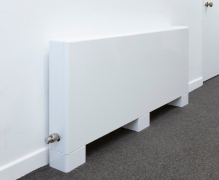

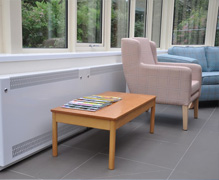
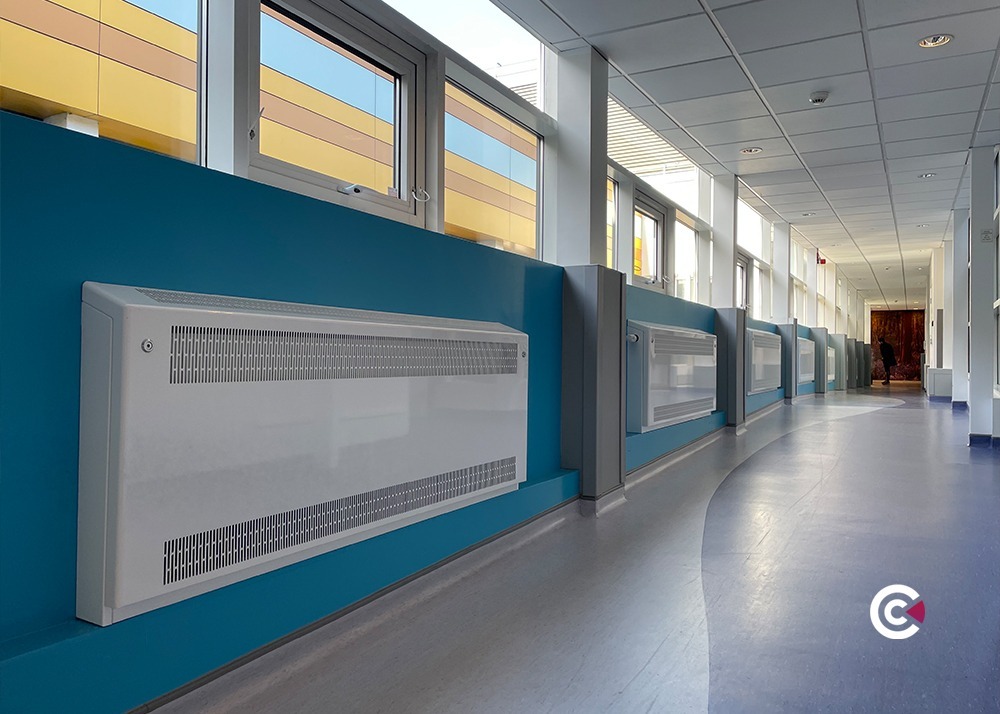
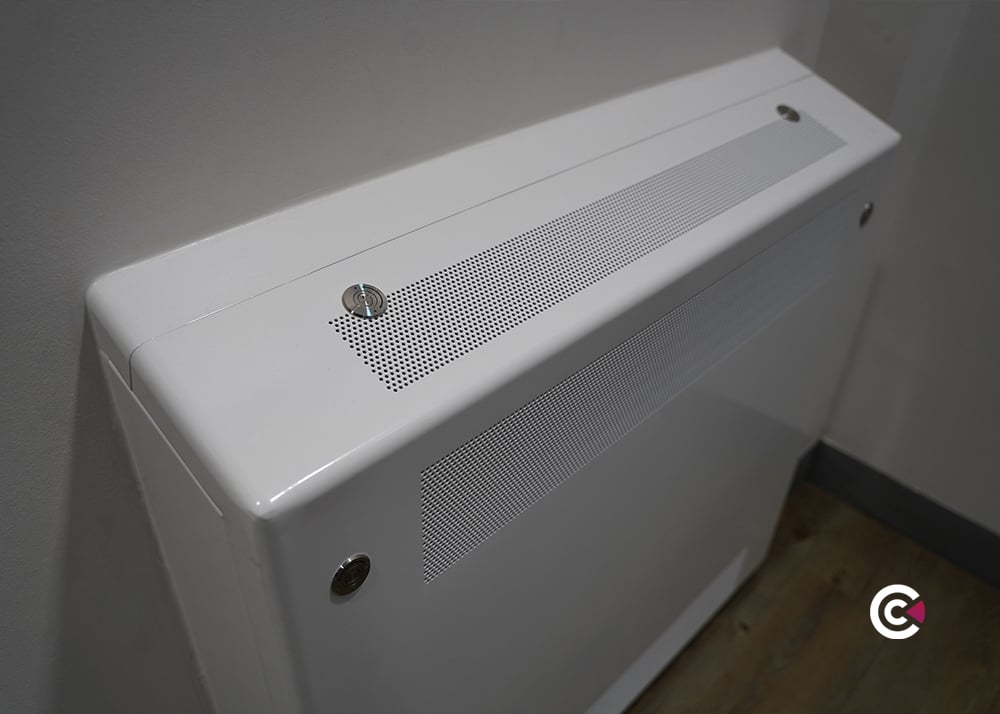




Getting the heat emitter sizing right is one of the most consequential decisions on a healthcare or education refurbishment — and one of the most commonly rushed
The gap between "it heats the room" and "it performs"
A radiator that heats a room is not the same as a radiator sized for the room.
In domestic settings, an undersized emitter is a nuisance. In a public-sector environment — a ward corridor, a CAMHS consultation room, a school classroom with 30 pupils — it becomes a performance shortfall, a comfort complaint, or a failure to meet design criteria. The needs are different. The process needs to reflect that.
This guide covers what accurate heat loss calculation looks like in practice, how to approach heat emitter sizing across different room types, and what data you actually need to get it right the first time. Whether you're a building services consultant redesigning a wing or an M&E contractor working through second-fix on a live ward, the fundamentals are the same — the room tells you what it needs when you look at the right elements.
Start with the building, not the catalogue
Before any product is selected, the room has to be understood on its own terms — as a set of thermal inputs and outputs.
That means collecting:
- Room dimensions — floor area, ceiling height, and any voids or service bulkheads that affect volume
- Construction details — wall U-values, glazing specification, roof/floor type, orientation
- Ventilation rate — mechanical or natural, air changes per hour, any dedicated fresh air supply
- Occupancy — number of people, type of activity, and hours of use (a busy physio gym produces very different internal gains to an overnight patient bedroom)
- Design temperatures — internal set point (typically 22°C for clinical spaces, 18–21°C for circulation) and external design temperature for your region
From these inputs, a heat loss calculation can be run — traditionally via CIBSE Guide A methodology, or through building services design software tools. The output is a figure in watts: the peak heat loss the room will experience under design conditions, which the heating system must be able to meet.
That figure is your baseline. Everything else; product type, output, positioning; flows from it.
Why public-sector projects complicate the calculation
Standard heat loss methodology is well-established. What changes in healthcare and education is the range of variables that sit around it.
Heat Pump adoption means flow temperature matters more than it used to.
NHS estates are increasingly being retrofitted for heat pump compatibility, which typically means lower flow temperatures — 45–55°C rather than the traditional 80°C. An LST radiator specified at a high delta-T will not deliver the same output when operating conditions change. Thermal performance tables at multiple delta-Ts are not a luxury at this point; they're a specification requirement.
Room type drives product type.
A side room in an acute ward and a corridor in a mental health PICU might carry identical heat loads on paper. The product solutions, though, are very different. One needs maintainable access and antimicrobial coating for IPC compliance. The other needs anti-ligature fixings aligned with the design principles set out in HBN 03-01, tamper-resistant construction. Heat loss gets you to the right wattage. Clinical context gets you to the right product.
Pipe centres and wall build-ups constrain your options.
In retrofit work especially, existing pipe positions and wall construction often dictate where a radiator can go and what connection centres are available. Standard BS EN 442 output data is tested under controlled conditions. Real-site offsets can affect output so it is worth confirming actual pipe positions before committing to a product dimension, rather than discovering the discrepancy during commissioning.
Heat emitter sizing: what "correct" actually looks like
Once heat loss is established, emitter sizing matches output to demand — with appropriate margin.
A common rule of thumb is to oversize by 10–20% to allow for an ageing system, intermittent occupancy patterns, or future-proofing for lower flow temperatures. In heat pump retrofit scenarios, the required margin may be significantly higher depending on system design — some projects call for much greater oversizing to maintain comfort at reduced delta-Ts. This is a project-by-project judgement, not a fixed rule.
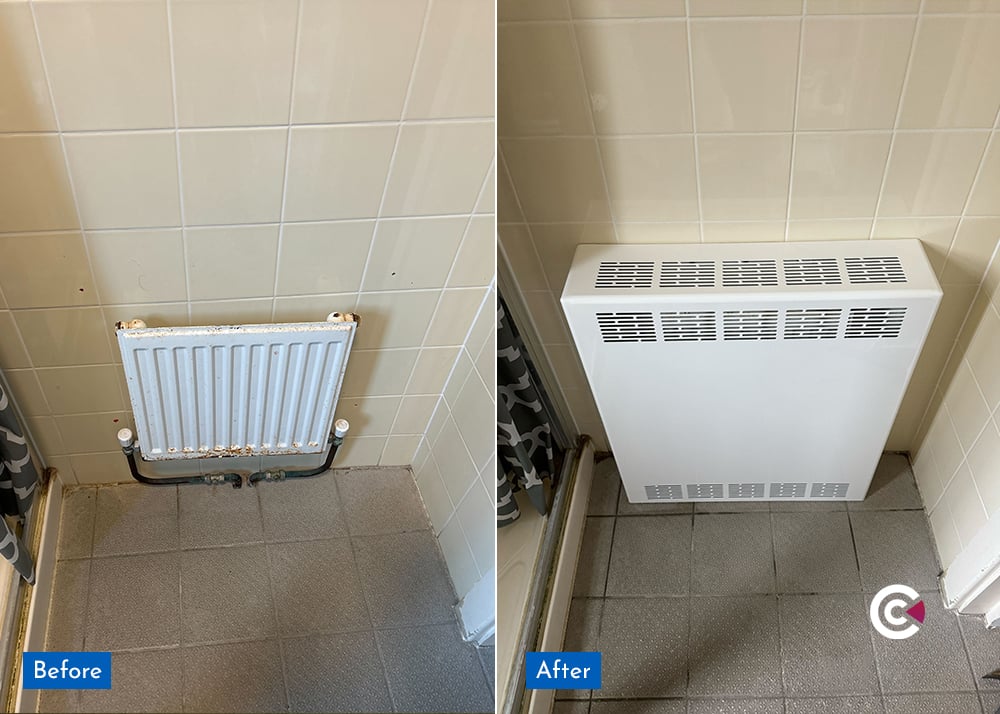
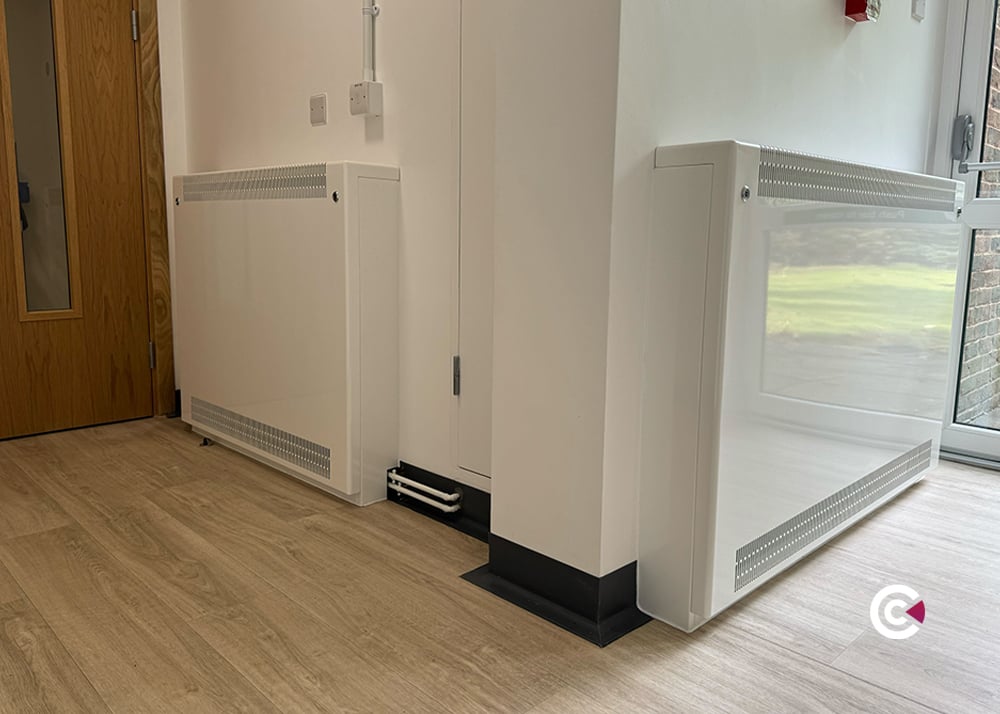
For LST radiators in clinical settings, HTM guidance emphasises surface temperature limits and safe application — the maximum surface temperature of 43°C referenced in BS EN ISO 13732-1 is the key constraint. In practice, this means selecting an LST product whose core radiator can deliver the required output within the guard's ventilation constraints — not simply using a standard radiator with a cover fitted afterwards.
Positioning is part of sizing. A radiator under a window offsets cold downdraught and distributes heat more evenly. A radiator in a corner may need increased output to compensate for reduced air movement. The calculation tells you the number; radiator location tells you whether that number will translate into comfort.
What room data is needed for heat loss calculations?
The short answer: floor area, ceiling height, construction U-values, ventilation rate, design temperatures inside and out, and occupancy profile.
The fuller answer for healthcare settings: add internal factors i.e.equipment or occupants, the design flow temperature of the heating circuit, and any clinical requirements. Isolation rooms, for example, may require negative pressure ventilation that changes the thermal balance significantly.
If you're working on a project where full as-built drawings aren't available (common in NHS estate refurbishments) a site survey is the most reliable way to gather the data you need. Confirming room-by-room requirements before specification is finalised removes a significant source of programme risk later on.
The emitters question: which product for which room?
Selecting the right type of heat emitter is a design decision, not just a procurement one.
In public-sector projects, the choice is typically driven by:
- Surface temperature requirements (LST mandatory in areas accessible to vulnerable people)
- Infection control (smooth, cleanable surfaces; no exposed fins; access panels for internal cleaning)
- Safety classification (anti-ligature specification in mental health settings)
- Whole-life cost (product lifespan, maintenance access, replacement frequency)
Each of these criteria can eliminate product types before a single output calculation is run. Getting them on the table early, ideally at RIBA Stage 2, avoids the more expensive process of substituting at RIBA Stage 4 or 5 under IPC or clinical team pressure.
Sizing is where projects get ahead — or fall behind
Done properly, heat loss calculation and emitter sizing remove uncertainty from the programme. The right product, in the right position, delivering the right output — with the clinical and installation constraints already factored in — is a substantially lower risk than a product chosen on price and adjusted later.
Contour's product range covers standard and bespoke LST radiator covers, anti-ligature guards, and DeepClean configurations — all with output data to support specification from Stage 2 through to commissioning sign-off. If you need thermal performance tables at specific delta-Ts, help confirming pipe centres, or a room-by-room schedule review, our technical team is set up to help.
For related technical guidance, visit the Contour Technical Hub, where you'll find product output data, HTM compliance documents, and specification resources for healthcare and education projects.
The Key Phrase: "Maximum Design Output"
This is critical. The surface must stay at or below 43°C even when the heating system is working at full capacity — not just under normal operating conditions. A radiator that meets the limit on a mild day but exceeds it in cold weather provides false assurance.
In short, the 43°C rule exists because the inability to feel or respond to pain is itself the hazard, and the building's heating system must compensate for what the occupant cannot do for themselves.
About Contour
We are specialists in the design, manufacture and installation of innovative high-quality safe surface temperature heating solutions and anti-ligature solutions. We have a ‘can do’ spirit and excel in meeting technically challenging specifications where quality is paramount.

%20(1).png)

/anti-ligature%20vent%20grilles.jpg)