-1.png)







What do "flow" and "return" mean on a radiator?
Ask someone to point to the flow pipe on a radiator and most people hesitate. The terms turn up in engineer conversations, product spec sheets, and maintenance reports without much explanation, which leaves anyone outside the trade guessing at what they actually describe.
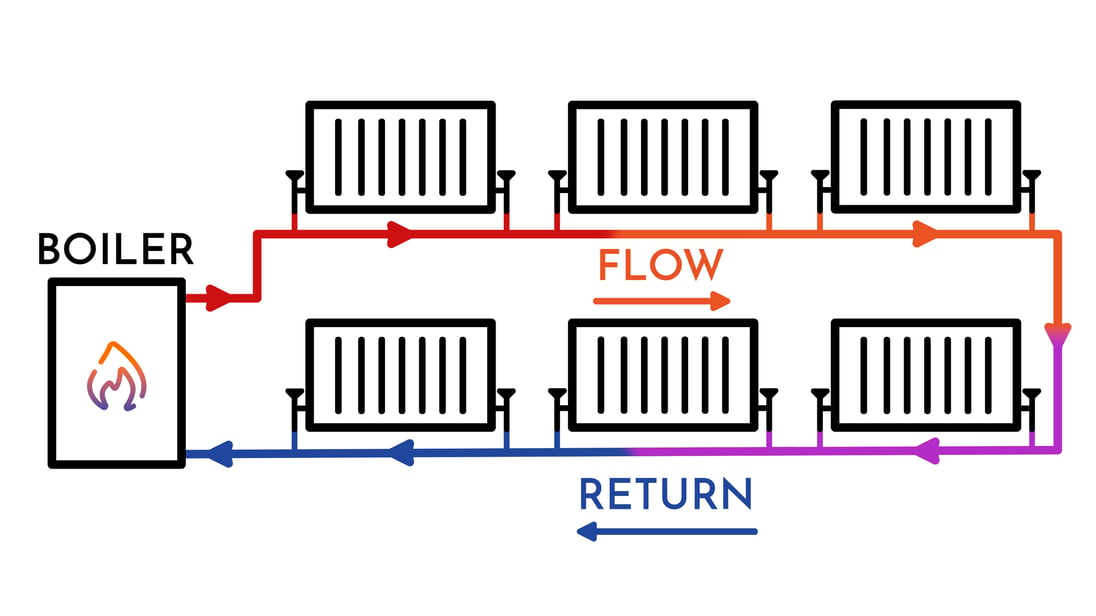
The answer is straightforward. Flow is the pipe carrying heated water from the boiler, heat pump, or other heat source towards the radiator. Return is the pipe carrying that water back out of the radiator and into the rest of the heating circuit, on its way to be reheated.
Water enters a radiator warmer than it leaves. That temperature drop is part of how a radiator does its job: heat passes from the water into the metal, then into the room, and the water carries on around the circuit cooler than when it arrived.
Every radiator sits somewhere within a wider loop: heat source, flow pipe, radiator, return pipe, back to the heat source. Knowing which pipe is which matters for anyone installing a radiator, tracing a fault, or working out why one room heats faster than another.
How water moves through a radiator heating system
A heating system runs on a cycle. Water is heated at the source, pushed around a network of pipework by a pump, and distributed to each radiator in turn. As water passes through a radiator, it gives up heat to the room and comes out cooler than it went in.
Radiators positioned nearer the heat source, or nearer the start of a pipe run, tend to get first access to the hottest water. By the time water reaches radiators further along the circuit, some heat has already gone into the radiators before it. Left unmanaged, this can mean radiators later in the run receive less heat than the ones before them.
Valves at each radiator control how much water passes through it, and the pipework layout, how radiators are connected, and in what order has a direct bearing on how evenly heat gets distributed. None of this needs to turn into an installation manual to follow: the practical point is that a radiator's position in the circuit affects the water it receives.
A small difference in how warm one radiator feels compared to another is normal in most systems. A persistent, noticeable gap, one room always cold, another always too warm, regardless of the thermostat setting, is a different matter. It often points towards a balancing issue.
What is radiator balancing?
Radiator balancing is the process of adjusting a heating system so that each radiator receives an appropriate share of the water moving through the circuit. It is a system-level adjustment, not a way to make one radiator run hotter on its own.
The main tool for this is the lockshield valve, usually the valve at one end of a radiator without a numbered dial, set once during commissioning or servicing and left alone during day-to-day use. Adjusting the lockshield valve changes the resistance to water flow through that radiator, which affects how much of the circuit's water passes through it relative to the others.
Balancing is often confused with two other things it isn't:
- Changing the desired room temperature. That's controlled by the thermostatic valve or the room thermostat, not the lockshield valve.
- Bleeding a radiator. Bleeding removes trapped air from the system. It can resolve a radiator that's cold at the top, but it doesn't address uneven distribution across a whole system.
A common assumption is that opening every radiator valve fully will improve heating performance. In practice, it tends to do the opposite: radiators nearest the heat source take more than their share of flow, leaving radiators further round the circuit short. Balancing works by deliberately restricting flow at some radiators so the system as a whole distributes heat more evenly.
What does balancing radiators mean? Radiator balancing means adjusting the lockshield valve on each radiator so that every radiator in a heating system receives a proportionate share of hot water, rather than the radiators nearest the heat source taking most of the flow at the expense of those further along the circuit. The result is a system that heats rooms at a similar rate, rather than one where some rooms warm quickly and others lag behind.
Why flow and return matter when balancing radiators
Flow and return aren't just labels for two pipes, comparing them is one of the main ways a heating system's performance gets checked.
When a system is properly balanced, the amount of water passing through each radiator reflects that radiator's size and the room's heat requirement, rather than simply its position in the circuit. Checking flow and return temperatures at a radiator gives an indication of how much heat that radiator is transferring: water should leave noticeably cooler than it arrived.
There's no single "correct" temperature drop that applies to every system. The appropriate difference depends on the system's design, the type of heat source, and the manufacturer's guidance for the specific radiators installed; a figure that's correct for one property or one product range won't necessarily apply elsewhere.
Poor distribution tends to show up in recognisable ways:
- Some radiators heat noticeably faster than others.
- Radiators further from the heat source staying cool even with the valve open.
- Rooms in the same building reaching different temperatures under the same settings.
- Certain rooms struggling to reach a comfortable temperature at all.
How radiator balancing is carried out
Balancing normally starts from a system that's already working correctly and free of obvious faults, trapped air should be cleared by bleeding the radiators before balancing begins, since air in the system will distort any readings taken.
At a high level, the process involves adjusting each radiator's lockshield valve to control the flow passing through it, then checking flow and return temperatures at the pipe connections to see the effect of that adjustment. Because radiators share the same circuit, changing one valve can change the flow available to others, so adjustments are usually made in stages and checked again, rather than set once and left.
For a domestic system with a handful of radiators, this is a task most heating engineers carry out as part of routine servicing. For larger, commercial, or healthcare heating systems — often with more zones, more radiators, and more variation in room use — a proper assessment by a qualified heating professional is the appropriate route.
Radiators, pipework, and valves can reach temperatures that cause burns, and adjustments to a live heating system are best left to someone competent to make them safely. This is practical guidance on what balancing involves, not an instruction to carry out the work.
Why balancing matters in healthcare and other demanding environments
Uneven heat distribution is an inconvenience in a house with a handful of radiators. Across a building with many rooms, zones, and radiators, a hospital ward, a care facility, a school, the same underlying issue is felt by more people, more often, and it can be harder to trace back to its source.
Predictable room temperatures support comfort and support the wider aim of a heating system doing its job without constant intervention from facilities staff. In healthcare settings, the considerations around radiator solutions go past temperature alone: patient and resident safety, ease of cleaning, accessibility, and how easy a system is to maintain over its working life all factor into how radiators, covers, and controls get specified and looked after.
Facilities teams working across large healthcare sites are often the first to notice when a system isn't behaving as it should, a ward that runs cold at one end, a room that never quite reaches a comfortable temperature regardless of the setting. Flow, return, and balancing sit behind that day-to-day picture, even where the terminology isn't the first thing anyone reaches for.
Flow, return and radiator balancing: the key points
Flow carries heated water towards a radiator. Return carries it away, back into the heating circuit. Radiator balancing is the process of distributing that water proportionately across every radiator in a system, using the lockshield valve, so no radiator is left short because of its position in the circuit.
Checking flow and return temperatures gives a practical read on how a radiator, and the wider system, is performing. Persistent uneven heating across a building is often a sign that a system needs balancing, though trapped air, a faulty valve, or a pump issue can produce similar symptoms, and each is worth ruling out before settling on a cause.
For anyone specifying or maintaining radiators across a larger site, particularly in healthcare and other settings where consistent, well-maintained heating carries extra weight, Contour Heating's guidance on radiator specification and healthcare heating is a reasonable next step to explore.

%20(1).png)

/anti-ligature%20vent%20grilles.jpg)